Updated: July 2026
When is the Best Time to Charter a Yacht in Komodo?
- Optimal Marine Conditions: Expect calm, glassy seas and exceptional underwater visibility, often exceeding 30 meters, perfect for diving and snorkeling.
- Peak Komodo Dragon Activity: The archipelago’s famous dragons are more active and visible during the drier, hotter months, especially during their mating season in July and August.
- Uninterrupted Itineraries: This window avoids the monsoon season, ensuring sunny skies for island-hopping, sunbathing on your private deck, and enjoying uninterrupted land excursions.
The low, resonant thrum of the ironwood hull is the only sound that punctuates the stillness. You’re anchored in a cove off Gili Lawa Darat, the morning sun just beginning to warm the teak deck under your bare feet. The air tastes of salt and smells faintly of the dry, volcanic earth from the island 200 meters away. Below, the water is a gradient of impossible blues, so clear you can trace the shadows of parrotfish flitting across the coral gardens. This is the essence of a Komodo journey, an experience where time itself seems to bend to the rhythm of the tides. But as with any expedition to one of the planet’s last truly wild frontiers, timing is not just a detail—it is everything. The question we hear most often from our discerning clients is a crucial one: “When is the absolute best time to charter a yacht in Komodo?”
Decoding Komodo’s Two Distinct Seasons
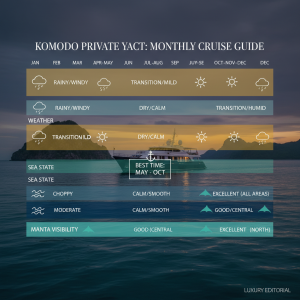
Unlike the four-season cadence many of us are accustomed to, the Komodo National Park, a UNESCO World Heritage site since 1991, operates on a simpler, more dramatic biannual cycle: the dry season and the wet season. Understanding the nuances of these two periods is the first step in crafting an impeccable itinerary. The dry season, running broadly from April through November, is the period most often recommended for a charter. During these months, the southeast monsoon winds bring arid air from the Australian continent. The result is minimal rainfall—Labuan Bajo sees an average of just 15mm of rain in August, compared to over 320mm in January—and day after day of brilliant sunshine. The landscape transforms into a vast, golden-brown savanna, reminiscent of Africa, and the seas are typically calm and predictable, making for smooth sailing between the park’s 29 islands.
Conversely, the wet season arrives with the northwest monsoon from December to March. This period brings higher humidity, cloud cover, and significant rainfall, usually in the form of intense but short-lived afternoon downpours. While this can mean rougher seas, particularly in January and February, it also triggers a dramatic transformation of the islands into a landscape of vibrant, almost electric green. For the traveler, the choice isn’t as simple as “good” versus “bad.” It’s about aligning the season with your personal priorities, whether they be world-class diving, uninterrupted sun, dramatic photography, or absolute solitude. Each season offers a distinct lens through which to view this prehistoric archipelago.
The Prime Window: Dry Season (April – November)
While the entire April-to-November period is considered prime time, it can be further broken down into three distinct phases, each with its own character. The early dry season, from April to June, is a personal favorite of many seasoned Komodo hands. The islands are still lush and green from the recent rains, but the skies have cleared. This shoulder season sees fewer vessels in the park, offering a greater sense of exclusivity. It also coincides with the peak of the manta ray season; the plankton-rich waters create a veritable festival for these gentle giants at cleaning stations like Karang Makassar. Underwater visibility begins to open up, consistently hitting the 20-30 meter mark.
July and August represent the absolute peak of the high season. The weather is at its most stable, with the driest conditions and seas often as flat as a mirror. This is the time for those who want to guarantee sun-drenched days on the pink sand of Padar Island and idyllic conditions for every activity. The trade-off, of course, is popularity. July brings the most international traffic. The beauty of a private yacht charter in Komodo is that the itinerary can always be adjusted to find a quiet anchorage, because the crews know the coves the day-trip boats do not. From September to November, the crowds begin to thin once more. The weather remains superb, and the sea temperatures are at their warmest, often reaching a balmy 29°C in the northern part of the park. This period offers a perfect balance of excellent conditions, active wildlife, and a more tranquil atmosphere, making it an ideal time for dedicated divers and those seeking a serene escape.
A Diver’s Calendar: Timing for Marine Encounters
For many who a yacht charter in Komodo, the world above the waterline is only half the story. The park sits within the Coral Triangle, an area boasting the highest marine biodiversity on Earth. Timing your trip to coincide with specific marine events can elevate a great dive trip into a legendary one. The headline act, the oceanic manta ray, which can have a wingspan of over 5 meters, is most reliably seen in large numbers from December through April, though sightings remain excellent into June. The nutrient-rich currents during these months create a feeding frenzy that is one of the underwater world’s greatest spectacles.
For those seeking larger pelagic species like reef sharks, giant trevallies, and tuna, the dry season from April to November is . The clear, calm conditions at legendary sites like Castle Rock and Crystal Rock provide a wide-open theater for this high-octane action. However, an insider’s tip is to pay attention to water temperatures. Komodo is unique in that it’s a confluence of the warmer Flores Sea to the north and the cooler Indian Ocean to the south. This means northern dive sites can be a comfortable 28°C while southern sites, fed by deep-water upwellings, can drop to a bracing 22°C. This southern chill, while requiring a thicker wetsuit, is precisely what makes sites like Cannibal Rock a world-renowned hotspot for rare macro critters and vibrant soft corals. According to the official Indonesia Travel portal, this thermal diversity is a key reason for the park’s incredible range of marine life, from pygmy seahorses to migrating whales.
The Komodo Dragon Factor: Timing Your Prehistoric Encounter
No trip to this region is complete without paying homage to its most famous resident, the Komodo dragon (Varanus komodoensis). Sighting these magnificent predators, which can grow up to 3 meters in length, is possible year-round, but your experience can vary significantly depending on the month. The most dramatic viewing often occurs during the dragons’ mating season in July and August. During this time, large males become more active and territorial, often engaging in spectacular bipedal wrestling matches to compete for females. It’s a raw, powerful display of nature that few ever witness. Following this, from September onwards, female dragons can be seen guarding their nests, a more static but equally fascinating behavior.
For a truly unique sighting, consider a charter around April. This is when the previous year’s clutches begin to hatch. The tiny, vulnerable dragons, measuring just 40 centimeters, immediately scramble up trees to escape predators—including their cannibalistic elders. While spotting these juveniles is a matter of luck, the possibility adds a layer of excitement to any trek on Rinca or Komodo Island. Regardless of the season, the key advantage of a private charter is the ability to control your schedule. Your crew can arrange for an early morning arrival at the ranger stations, allowing you to be on the trails when the dragons are most active in the cooler morning air, long before the heat of the day and the arrival of larger tour groups from Labuan Bajo. It’s the difference between a fleeting glimpse and a profound, personal wildlife encounter with the estimated 3,000 dragons remaining in the wild.
The “Green Season” Gambit: Is a Wet Season Charter Worth Considering?
While the dry season is the undisputed champion for reliability, dismissing the wet season (December-March) entirely would be a mistake. We refer to it as the “Green Season,” and for a certain type of traveler, it holds a unique allure. The rains bring a startling transformation to the archipelago; the parched, savanna-like hills erupt into a blanket of emerald green, and seasonal waterfalls cascade down cliffsides. The visual drama is immense, offering a completely different photographic palette. This period also sees a dramatic drop in visitor numbers, meaning you may have world-famous sites like Padar Island’s viewpoint almost entirely to yourself. The solitude is palpable.
Of course, there are considerations. You must be prepared for daily, albeit usually brief, rain showers. The sea can be choppier, and some northern dive sites may occasionally be inaccessible due to surface conditions. Underwater visibility can also be reduced. However, for experienced divers, the nutrient-rich water can attract different kinds of life, and the manta ray encounters are at their absolute peak. “A Green Season charter is not for the first-time visitor who wants guaranteed sunshine,” advises our lead Indonesia specialist. “But for a seasoned traveler, a photographer, or someone who values solitude above all, a carefully planned itinerary in late March or early December can be an incredibly rewarding experience.” The expertise of our Komodo private yacht curators is paramount here, as they can design flexible itineraries that maximize opportunities and navigate the specific conditions of the season.
Quick FAQ: Your Komodo Charter Questions Answered
What about peak holiday periods like Christmas and Easter?
These are exceptionally popular times. Christmas and New Year’s fall within the wet season, so expect lush landscapes and some rain, but the festive atmosphere is unique. Easter typically marks the beautiful transition into the dry season. For either period, we strongly advise booking your charter 12 to 18 months in advance to secure your preferred vessel.
How does the moon phase affect a charter itinerary?
This is an excellent and often overlooked question. The full and new moons create the strongest tidal currents in Komodo’s channels. For divers, this can be a double-edged sword. Novices may find the currents challenging, but for experienced divers, these strong currents bring out the big fish—sharks, tuna, and giant trevallies become much more active. Your captain will always plan dive schedules around the tides for maximum safety and enjoyment.
Is a shorter 3- or 4-night charter sufficient?
While possible, we find that a charter of this length feels rushed. It allows you to see the “greatest hits” like Padar Island, Pink Beach, and a dragon trek on Rinca. However, to truly immerse yourself in the magic of the park, explore more remote dive sites, and find true tranquility, we recommend a minimum of 5 nights. Our most satisfied clients often book 7- to 10-night journeys, allowing for a pace of travel dictated by discovery, not the clock.
Ultimately, the “best time” for a private yacht charter komodo expedition is a deeply personal choice, weighing the dance of the seasons against your own desires for adventure, serenity, and discovery. Whether you dream of swimming with congregations of manta rays in the vibrant Green Season or watching Komodo dragons duel under the golden sun of the dry season, the key is meticulous planning. The archipelago’s wild beauty is constant, but the experience is ever-changing. To navigate these nuances and craft a journey that is truly seamless, contact our specialists at the Private Yacht Charter Komodo network. We are here to translate your vision into an unforgettable reality.